

How can you recognise a recurring pattern?
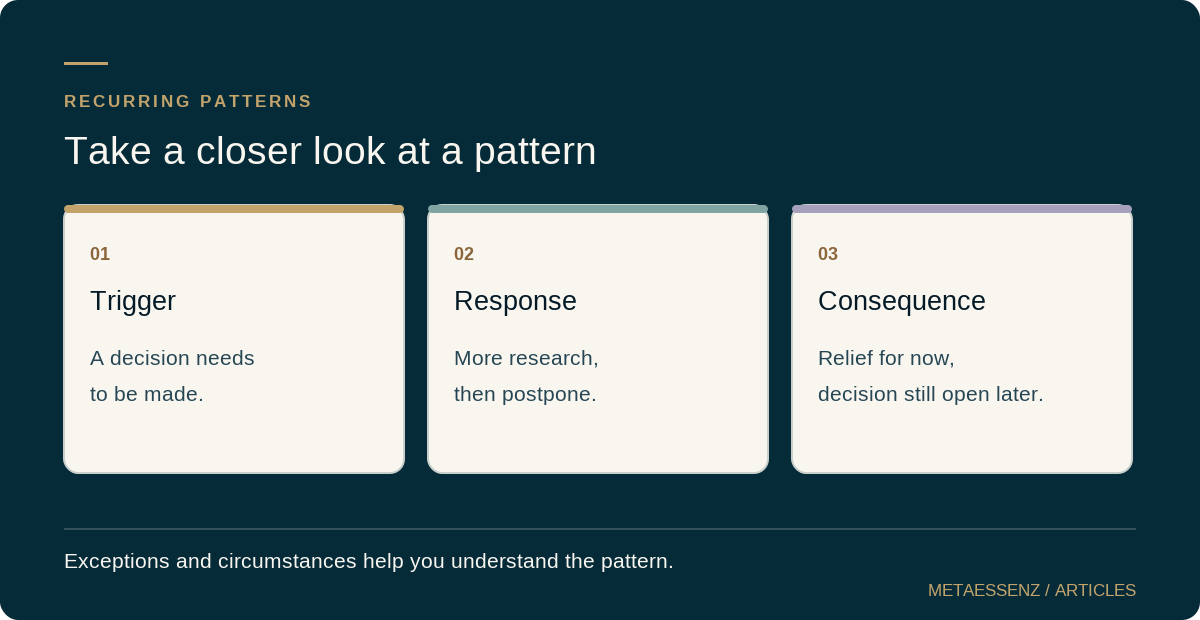
Record the same four points for both situations:
- Trigger: What happened just before?
- Response: What did you think, feel and do?
- Consequence: What happened immediately and later?
- Exception: When did it go differently? What was different then?
Separate observation from interpretation. “I agreed immediately twice” describes an event; “I cannot set boundaries” is a conclusion. Two similar experiences offer a starting point, not proof of a fixed pattern. Notice when things go differently, too.
Recognising behaviour patterns: 7 examples
These examples are observation prompts, not personality types.
- People-pleasing: You say yes when you mean no. Is a request for time respected?
- Withdrawal in relationships: The more one person asks, the further the other withdraws. When does the conversation go differently?
- Justifying yourself: When you receive feedback, you immediately explain your actions. What happens if you ask for a specific example first?
- Perfectionism: You keep revising work that already serves its purpose. What actually needs improvement?
- Rumination: You replay a conversation repeatedly. Is there new information?
- Taking too much responsibility: You repeatedly take on other people’s tasks. What did you agree to, and what was added later?
- Postponing decisions: When a change becomes realistic, you keep researching. What information would genuinely change your choice?
Your response, your circumstances, or both?
You work late again. The outcome looks the same from outside, but the reasons may differ:
Look for a day when another request did not lead to extra hours. Did you respond differently, was the task smaller, or was there a clear priority? Perhaps someone else took responsibility. Such differences help narrow down possible explanations.
What originally suited you? What changed? You need not automatically change yourself or leave everything behind. Consider a new agreement or more room for your own interests. Explore your options in When life no longer fits.
Breaking old patterns: four steps
- Observe: Compare specific situations rather than judging yourself.
- Find a starting point: When do you first notice that something is wrong? Where can you make a difference? What needs to change around you?
- Experiment: Choose a small, safe step. For example, “I'll check my tasks and get back to you.”
- Review: Did the outcome change? Was your own work manageable? Keep what helps; otherwise try another approach.
Use the reflection worksheet to record your observations.
Reflection worksheet
Exercise: recognise your own pattern
Choose two similar, manageable situations and, if possible, an exception. This is a reflection exercise, not a diagnostic test or therapy.
No account required. Entries are not sent to MetaEssenz or stored in cookies or website storage. Your browser may retain them temporarily. Save notes yourself; avoid sensitive details on shared devices.
Why do patterns repeat?
A familiar response may bring immediate relief but have later costs. Repetition in similar circumstances can make habits more automatic (Lally et al., Keller et al.). These studies concern simple habits, not the causes of complex relationship patterns.
Agreeing may avoid an uncomfortable conversation, while the cost becomes clear later. Other people may also get used to your response. Consider the interaction, rather than the habit in isolation.
What role do beliefs play?
“I must not disappoint anyone” could encourage you to agree. Check whether that thought actually occurs.
Why recognition alone is not enough
If you notice the crucial moment only afterwards, prepare an alternative. Next time, observe whether the other person allows it.
Example: postponing a decision
Alex is considering a career change. When an option becomes realistic, new questions arise. Alex researches further, feels some relief, and starts searching again weeks later. What information is really missing, and what would Alex do with it?
Uncertain finances need a calculation; unresolved agreements need a conversation. If the direction is clear, an informal meeting might make the next step manageable.
“I'm indecisive” becomes a specific question.
Symbolic perspectives
Symbolic models may suggest reflection questions; they cannot establish psychological causes.
When is self-reflection not enough?
Stop if the exercise causes distress. If recurring situations affect daily life, seek medical, psychological or psychosocial support. With threats, violence or immediate danger, protection and urgent help take priority. You are not responsible for resolving violence or threats by changing your own response.
For guidance in England: NHS mental health services. Elsewhere, contact local services.
Frequently asked questions
Is a recurring pattern the same as a habit?
Habits are learned actions. Patterns can also involve recurring thoughts, feelings and responses.
Why do I repeat patterns I already recognise?
Understanding and acting differently are distinct. Practice and suitable conditions help; see the four steps.
How can I recognise and change a relationship pattern?
Compare both people’s actions and an exception. If it feels safe and both wish to, agree on a pause and when to resume the conversation. If boundaries are violated, protection and support come first.
Are recurring patterns always harmful?
No. Helpful habits and reliable responses can also recur.
How long does it take to change a pattern?
There is no fixed timeframe. Studies of simple habits show different trajectories and do not establish one for complex patterns. Notice whether responses and consequences change in everyday life.
What is the difference between a thought pattern and a behaviour pattern?
Thought patterns concern recurring interpretations; behaviour patterns concern repeated actions. Similar actions may have different reasons.
Sources and context
The sources explain habit formation and links between thoughts, feelings and behaviour. They do not establish this exercise’s effectiveness or individual causes. Examples and exercises are editorial prompts. Sources reviewed: 26 November 2026.
- NHS: Cognitive behavioural therapy (CBT)
Professional psychological treatment, not our reflection exercise.
- Keller et al. (2021): Habit formation following routine-based versus time-based cue planning
Randomised study of simple nutrition habits.
- Lally et al. (2010): How are habits formed? Modelling habit formation in the real world
Primary research on varying habit formation timelines.
- NHS: Mental health services
Guidance on professional support in England.
When you would like to explore a question personally
For a specific life question, Seelenblick offers a written symbolic reflection and a 20-minute conversation. It is not a psychological analysis or therapy.
Several life areas: Seelenarchitektur. Free starting point: self-reflection check.